
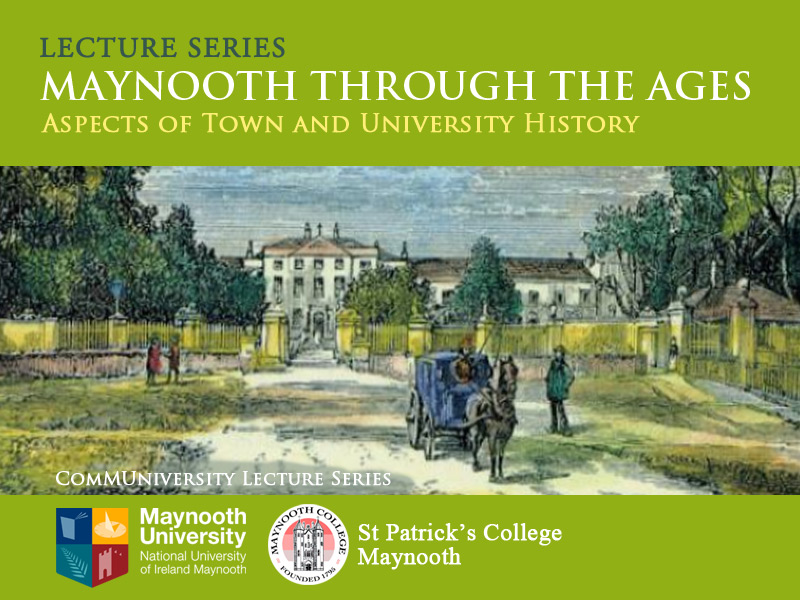
Department of History in Association with Maynooth University Library, and St Patrick’s College, Maynooth presents
Maynooth Through the Ages Fourth Annual Lecture Series
All lectures are free to the public.
Booking for each talk is essential. See below for details and links.
Monday, 9 February – 19:00-20:30
Paul Croghan, Maynooth: From Fitzgerald Castle to commuter town
From Fitzgerald Castle to commuter town traces the development of Maynooth over the past 850 years. The establishment of the Geraldine Castle where two rivers meet, created the focal point from which a settlement developed. This development has been significantly influenced by the fortunes of the Fitzgeralds, and generations of the family played their part in the creation of Maynooth. As earls of Kildare and later as dukes of Leinster, they were respected politically, with links to the monarchy. It can be argued that Maynooth at times was considered as the capital of Ireland. The creation of a village that reflected their importance has given us probably the best surviving example of a planned landlord town in Ireland. Throughout Ireland’s history, whether the issue was religious or political freedom or indeed the land issue, Maynooth and its people have played a significant part. Since the beginning of the twentieth century, the proximity to Dublin has also been a factor on how Maynooth has developed. The evolution of Maynooth as a commuter town reflects the change from a key agricultural centre to a service centre to meet the needs of our residents. Important too has been our continued and expanded significance as a centre of education. Key features of this settlement, we call Maynooth.
Paul Croghan is the Chairperson of the Maynooth Local History Group who are leading the Maynooth 850 celebrations. Born in Roscommon Town, he came to live in Maynooth in 1990. Since then, he has been very active in many community groups and activities here. These include groups dealing with issues like education, better planning, tidy towns, the St Patrick’s Day Parade and community development. He has also been involved in countywide organisations including the Kildare Local Development Company and the community structure within the local authority. He has always had an interest in history and heritage and was the first Chairperson of the County Kildare Heritage Forum. In Maynooth, he has been involved in the publication of the historic walks booklet as well as the project to select and deliver a Maynooth Town Crest which now features on all of the street signage in the town. He was also part of the group that produced the “Book of Maynooth” which was a millennium project to record local art and poetry on vellum and this book is now in the custody of Maynooth local library.
This lecture will be followed by the official launch of the ‘Maynooth 850’ celebrations by Professor Terence Dooley, Department of History, Maynooth University.
Monday, 16 February – 19:00-20:30
Liam Kenny ‘Troops don’t behave like clerics’: Carton House in wartime 1941-43
Carton House is among Ireland’s grandest houses and a long-time residence of the ducal Fitzgeralds. Less well known is its role at the forefront of Ireland’s anti-invasion precautions during the fraught years of “the Emergency” in the 1940s. This talk will present the cast of characters who flitted through the house as it hosted the headquarters of a military operation intended to fend off unwelcome attention by wartime belligerents.
Liam Kenny is a current postgraduate student of Irish History in Maynooth University. He has written extensively on Co Kildare’s local history and broadcasts on KFM local radio.
Monday, 23 February– 19:00-20:30
Sarah Larkin, The Salamanca Archive and Maynooth College
This talk will look at the Salamanca Archive, which contains the archives of the Irish Colleges in Salamanca, Santiago de Compostella, Seville, Madrid, Alcalá de Hernares, and Lisbon which are kept in the St Patrick’s College, Maynooth archives. The presentation will highlight records from the collection, as well as explore the links between the Irish Colleges and Maynooth College.
Sarah Larkin is the archivist for St Patrick’s College, Maynooth. She holds a BA (Hons) in Fine Art & History of Art, and an MA in Archives and Records Management. She has worked as a professional archivist in religious archives for over ten years and has been working in St Patrick’s College since 2017.
Monday, 2 March – 19:00-20:30
Denis Bergin, Maynooth and ‘its’ Colleges: Town, Gown and Renown?
Denis Bergin has been involved with the life and heritage of Maynooth’s historic college campus for more than sixty years, as student, alumnus and convenor since 2013 of a movement to document and highlight significant people and places in the unfolding of a 200-year-plus narrative. In this presentation he will apply his lifelong trade as writer and editor to investigating some of the issues and discoveries that have arisen in his pursuit of the amazing story of ‘the miracle on the Lyreen’ – how an isolated and hidebound institution became an open, diverse and adventurous centre of learning, located in a thriving country town with the potential to be a future Oxford or New Haven. Along the way he will include accounts of some unusual happenings and coincidences, as well as a few offbeat observations, with subjects that include a love story that begins in Stoyte, Tomás Ó Fiaich’s Very Short History of Ireland, when Maynooth became Ballymena, the curse of the Ardagh scientists, Mary O’Rourke and the mill connection, the Italian professor who tried to save Ireland, the Carton-related Augustinian on the way to sainthood, six world-class alumni you’ve never heard of, and a local citizen’s wish list for future prosperity.
Denis Bergin is a native of the Kilkenny-Laois north-east border area. He is a 1966 graduate in Arts of the National University of Ireland recognised college on the historic Maynooth College campus, whose heritage he has been involved in documenting and publicising in recent decades as an initiative of his fellow class members. He has lived and worked as a communications consultant to the commercial, institutional and heritage sectors on both sides of the Atlantic, and for most of the past twenty-five years has been honorary director of the James Hoban Societies of Ireland and the United States, dedicated to researching and promoting the work of the Kilkenny-born architect and constructor of iconic buildings in early Washington DC. He now lives with his wife Carol in West Offaly and on the eastern Algarve coast in Portugal.
Monday, 9 March – 19:00-20:30
Eamon Healy, Tracing your Maynooth ancestors: A practical guide to free online resources
Discover how to trace your Maynooth ancestors using free online resources. This beginner-friendly session covers essential Irish genealogy records—census returns, civil registration, church records, and Griffith’s Valuation—with a focus on the Maynooth area. Learn a proven research sequence, explore key websites, and see a worked example tracing a local family through the records. You’ll leave with practical skills to begin uncovering your family’s story.
Eamon Healy has worked as a professional genealogist at Ancestry.com for over a decade, helping thousands trace their Irish roots. He recently completed his PhD in History at Maynooth University, where his research examined administrative responses during Ireland’s Great Famine. Eamon combines hands-on genealogical expertise with academic research to make Irish family history accessible.
Monday, 23 March – 19:00-20:30
John Paul Sheridan, Tour of the Historic Buildings of the South Campus
Since its foundation in 1795 and the acquisition of Stoyte House, Maynooth College has made a considerable contribution to architecture. The overall design of the campus has left us with a beautiful place to work, live and study.
Rev. Dr John-Paul Sheridan has been a member of the faculty of St. Patrick’s Pontifical University since 2013 and works in the area of Theology and Education. His interest in the history of the college, in particular the College Chapel goes back to his time as a seminarian at Maynooth in the 1980s.
Monday, 30 March – 19:00-20:30
Terence Dooley, The Irish Land Commission in Maynooth and Kildare
For most of its existence from 1881 to 1992, the Land Commission was the most important state body operating out of rural Ireland where its long tentacles spread into every nook and cranny, as, indeed, its ghost continues to do. It began life as a regulator of fair rents but soon evolved into the great facilitator of land transfer, and by extension the main instigator and architect of rural reform.
This lecture will look at the impact of the Land Commission on Co Kildare, and, where appropriate, on the Maynooth area. It will provide historical background to the Commission’s establishment, before examining the role it played in land transfer up to independence, and in land redistribution and migration schemes after 1922. The lecture will conclude with a discussion on the possible reasons why its archives have not yet been opened to the research public (except on an extremely limited basis.) While no one has officially admitted that they might reveal a great deal of political corruption and skulduggery, it is a possibility that is hard to dismiss.
Terence Dooley is Full Professor of History at Maynooth University and Director of the Centre for the Study of Historic Irish Houses and Estates.